
If you are closing a UAE business, a license cancellation service can help you organize the required closure steps and paperwork. Closing a company involves more than submitting a form, especially when employee records, visas, company accounts, or government clearances still need attention. The right support can help you understand the steps that apply to your business and prepare for them without promising a particular outcome.

You may be ending operations, changing your business plans, or winding down an entity that no longer serves you. Each situation has its own records and outstanding obligations, so practical guidance should fit your company rather than rely on a generic checklist. Have your current license and company details ready so you can get guidance suited to your business.
Key Takeaways
- Formal closure involves more than stopping business activity.
- Your license issuer and entity type shape the required route.
- Employee, visa, tax, and premises records may need separate attention.
- Prepare current company records before starting an application.
- The licensing authority decides whether closure requirements are complete.
What Does License Cancellation Mean for a UAE Company?
A company does not complete formal closure simply by stopping its business activity. Formal closure means dealing with the trade license and the company records that remain open, rather than leaving an inactive business on an authority’s register.
Company liquidation is the formal winding-up of a company, including settling its liabilities and completing required closure steps. Stopping operations and completing formal deregistration are different actions. The company may still have obligations even after it has stopped trading, so an owner should not treat inactivity as proof of closure.
Stopping business activity does not close the company’s trade license or settle its remaining obligations.
A cancellation process may involve the licensing authority and other organizations that hold company records. Depending on the business, you may need to address employees, sponsored visas, taxes, a lease, or accounts before the final trade license cancellation certificate is issued.
Federal Law No. 2 of 2015, Articles 306-326, describes grounds for company dissolution. These include the end of a company’s duration, achievement of its purpose, loss of most or all assets, a shareholder decision, or bankruptcy. These examples help explain when dissolution may arise, but they are not a complete legal opinion for every company.
The appropriate route depends on the company’s legal form, current status, and licensing authority. A company that has changed owners, stopped work, or fallen behind on obligations may need a different assessment than a business whose owners have formally approved liquidation.
Use your current license and company records to establish what is still active. That can include permits and registrations held outside the licensing authority, not just the license itself. Confirm the company’s legal form and current status before deciding which closure route applies.
Which Cancellation Route Applies to Mainland and Free Zone Companies?
Your first route check is whether the license is mainland or issued by a free zone. The license issuer is the starting point for identifying the licensing authority and its cancellation process.
Mainland businesses generally use the relevant Department of Economic Development route, while free zone companies apply to their own authority. DED or ADDED may be the relevant mainland authority, depending on the emirate. A similar-sounding closure step does not mean two authorities use the same forms or accept the same documents.
| Route | Licensing authority | Route-specific considerations |
| Mainland | DED or ADDED | Government clearances and applicable liquidation steps |
| Free zone | Relevant free zone authority | Its own forms and procedures |
| DDA FZ-LLC or branch | Dubai Development Authority | Deregistration under Private Company Regulations |
| DDA freelancer | Dubai Development Authority | Freelancer license cancellation under Private Company Regulations |
Free zone companies such as those licensed by DMCC, JAFZA, IFZA, Shams, and Dubai Silicon Oasis follow their respective authority’s procedures. The licensing authority may set its own application forms, approval stages, and supporting document requirements. Check the exact issuer shown on the license rather than relying on a general description of a free zone.
For covered entities, Dubai Development Authority applies its Private Company Regulations to deregistration and cancellation. The rules cover FZ-LLCs, branches, and freelancer licenses, but the relevant steps depend on which of those license types you hold.
The broad terms mainland and free zone identify different routes, not a single checklist for every business. Government services and clearances can also depend on the emirate, business activity, and company records. Use the authority printed on the current license to confirm the correct application route.
How Does the Trade License Cancellation Process Work?
For an LLC requiring liquidation, the process starts with formal shareholder approval and a liquidator appointment. Written authority gives the liquidator a clear basis to handle the company’s winding-up steps.
The company must complete the required liquidation and clearance stages before the licensing authority issues its final trade license cancellation certificate. The route below describes a common LLC process; the exact filing channel depends on the licensing authority and company type.
Authorize the closure and appoint a liquidator
Shareholders or the general assembly approve liquidation through notarized minutes. The resolution authorizes the closure and names the liquidator. The liquidator then provides an official letter confirming the appointment and accepting the role.
The resolution should match the company’s legal records and make the intended action clear. If owners act through a representative, the authority may also require proof that the representative can act for them. A missing signature or unclear appointment can hold up the initial filing.
Submit the initial request and publish the notice
The company submits an initial request to DED, a free zone authority, or another approved channel. After the initial review, the authority issues a liquidation certificate at an earlier stage of the process. This certificate is not the final trade license cancellation certificate.
The company then publishes a closure announcement in two regional newspapers. The notice informs creditors and starts the period in which they can submit claims. Keep copies of the published notices and the publication date with the company’s closure records.
Complete clearances and obtain the cancellation certificate
Creditors have 45 days from publication to submit claims. After the claim period, the company completes a final declaration and resolves the requirements that apply to its records. That may include clearances from other authorities or service providers.
The company pays the required fees and submits the final paperwork to the licensing authority. Once the authority accepts the clearances and final submission, it issues the trade license cancellation certificate. Keep the newspaper publication date on file because it starts the 45-day creditor claim period.
What Documents Should You Prepare?
Start with the company’s current license, ownership documents, and written approval to close. Current copies help the authority match the application to the company’s active records.
A complete, up-to-date application can reduce requests for corrections or resubmission. The exact requirements depend on the company and licensing authority, so prepare the common records below and compare them with the current official checklist.
- Copy of the current trade license.
- Memorandum of association, or MOA, and any amendments.
- Shareholder resolution approving closure.
- Shareholder Emirates ID and passport copies.
- Power of attorney if a representative is applying for the owners.
- Supporting bank, lease, and staff settlement records where applicable.
The MOA and amendments help show who can approve the closure and whether the company’s ownership records are current. The resolution should identify the decision being made. The authority may request a particular form or wording, so an old resolution for another purpose may not be enough.
A representative may need a power of attorney that covers the actions required for the application. A bank closure letter, lease clearance, or proof of staff settlement may also be requested, depending on the company’s position and the licensing authority’s rules.
Check that names, license details, and ownership information match across the application and its attachments. A passport or Emirates ID copy that is out of date, or an MOA that does not include a later amendment, may lead to a correction request.
Missing or outdated paperwork can lead to a request for corrections or a resubmission. Requirements can vary by entity type and authority, so do not assume another company’s checklist applies to yours. Compare every document against the relevant authority’s current checklist before you submit.
Which Government Clearances May Be Required?
Final closure can depend on clearing more than the licensing authority’s own records. Separate records may remain open with labor, immigration, tax, utility, or premises organizations.
Clear only the records and accounts that apply to your company, then obtain confirmation from each relevant organization. The agencies involved depend on whether you have registered employees, company-sponsored visas, tax registrations, or a physical business location.
Labor and immigration records
The Ministry of Human Resources and Emiratisation, or MOHRE, handles labor files, work permits, and employment contracts for businesses under its system. GDRFA handles residence visas issued under company sponsorship. These are separate records, so clearing a labor file does not by itself close a sponsored visa.
A free zone company may follow its own labor and immigration process or work through the relevant government channels. Check which organization holds each record before asking for closure confirmation.
Tax registration and final returns
A VAT-registered business may need to apply for VAT deregistration through FTA e-Services. The business may also need to settle tax liabilities and submit final returns. VAT status and other tax obligations affect which steps apply, so review the company’s registration and filing position.
Tax deregistration is distinct from trade license cancellation. A company should not assume the licensing authority closes tax records as part of its own process.
Premises, utilities and telecom accounts
A business with a physical location may need to close utility or telecom accounts and obtain premises clearances. Examples include DEWA, ADDC, e&, du, municipality, and Civil Defence. Which clearances apply can depend on the activity, site, and services in use.
| Authority or provider | Record or clearance | When it may apply |
| MOHRE | Labor file and work permits | Businesses with registered employees |
| GDRFA | Sponsored residence visas | Businesses sponsoring owners or workers |
| FTA | VAT deregistration and final tax steps | VAT-registered businesses |
| Utility or premises provider | Account and site clearance | Businesses with premises or active service accounts |
One company may need a labor confirmation but no premises clearance; another may have active utilities and no employees. Ask each relevant organization for confirmation that the company’s specific record or account is closed.
How Should You Close Employee and Sponsored Visa Records?
List every employee and company-sponsored visa holder before starting the final closure stage. People’s records are separate from the company’s trade license and need their own applicable steps.
Company closure may require labor card and employment contract cancellation through MOHRE or the relevant free zone authority. Residence visas sponsored by the company, including owner, partner, and employee visas, must be addressed through GDRFA or the relevant free zone process.
Use a short record check before filing the final closure request:
- Identify every active labor card or work permit.
- Resolve employment contract status and employee dues.
- Identify partner and employee visas sponsored by the company.
- Confirm the applicable MOHRE, GDRFA, or free zone steps and obtain closure confirmation.
The authority responsible depends on where the company and employee records are registered. A mainland employer may have records handled through MOHRE, while a free zone employer may use its own authority’s process. Do not assume that one route applies to every worker.
Employment contract status and employee dues deserve attention alongside the record itself. If the company has an active employee file, check what remains open before treating that person’s employment record as settled.
Sponsored residence visas require a separate review. The company should identify each owner, partner, or employee whose visa is linked to its sponsorship and confirm the correct cancellation or transfer steps with the responsible authority.
Keep written confirmation for labor and immigration records with the company’s closure file. Do not assume a trade license closure by itself cancels an individual’s employment or residence record.
How Long Can Trade License Cancellation Take?
Plan for roughly 60-90 days when your LLC closure requires liquidation and a creditor notice. The notice period alone takes 45 days, before all clearances and final review are complete.
A simpler authority-dependent application can take less time, but its estimate does not apply to every LLC liquidation. Processing time depends on the route, the company’s records, and how quickly required approvals arrive.
LLC liquidation and creditor notice
The 60-90-day estimate for LLC cancellation and liquidation includes the 45-day creditor notice. Government clearances are estimated at 1-2 weeks per authority, and final review can take 5-10 business days. Each stage may add time if an authority needs more information.
The notice period is part of the process, not simply a queue that can be removed by faster paperwork. If several authorities hold open records, their review time can extend the overall period.
Abu Dhabi application routes
Abu Dhabi cancellation applications may take 3 days to 2 weeks through TAMM or ADDED. That range depends on business activity, partner count, and document readiness. It describes a different, authority-dependent route and should not be promised for every LLC liquidation.
Before using this shorter range for planning, make sure it matches the company’s entity type and required closure steps. An LLC that requires liquidation and a creditor notice follows a longer process.
Common causes of delay
Incomplete documents can pause an application while the company corrects or replaces records. Outstanding clearances can also extend the schedule, especially when more than one organization must confirm its records are closed.
Delays obtaining partner or employee records are another practical risk. Missing signatures, unresolved employment records, or unanswered requests can prevent the next stage from moving forward on schedule.
Ask which stage is active and what item is holding it up if processing stops. Build the notice period into your schedule rather than treating it as an avoidable processing delay.
What Costs Make Up a Trade License Cancellation?
For an LLC, the overall cancellation estimate provided for this process is AED 8,000-15,000, but it is not a fixed fee. The total depends on company size, employee count, licensing authority, and outstanding liabilities.
Expect costs to come from authority charges, employee records, liquidation work, documents, and any open obligations. A company with no registered employees or active accounts may have a different bill from one with several records to close.
Licensing authority and employee charges
The licensing authority may charge for processing the license closure. The emirate and license type affect the applicable amount. Labor card cancellation charges may also apply when employees are registered, and the employee count and record status can change that part of the total.
Ask for authority charges to be listed separately from professional support. That makes it easier to see which amounts relate to the application and which depend on the company’s case.
Liquidation and document expenses
Cases requiring liquidation may involve a liquidator, newspaper advertising, notary work, and legal documents. The number and type of required documents can affect the cost. A company should also ask whether resolution preparation or other application work is included in a service quote.
Clearances and outstanding obligations
Companies with active obligations may incur costs for other clearances or unpaid accounts. The organization involved and the account or liability status affect what remains due. Those amounts are separate from the licensing authority’s fee.
| Cost component | When it may apply | What affects it |
| Licensing authority fee | All license closures | Emirate and license type |
| Labor card cancellation | Companies with employees | Employee count and record status |
| Liquidation and documents | Cases requiring those steps | Liquidator, newspaper, and legal-document needs |
| Other clearances | Companies with active obligations | Authority and outstanding account or liability status |
A quote should distinguish fixed authority charges from costs that depend on the company’s records. Request an itemized estimate that separates authority charges from professional and case-specific costs.
What Can Happen If You Leave a Trade License Active?
Stopping business activity does not itself prove that the company’s license and related obligations have been closed. An inactive company may still have open records, fees, or duties with the licensing authority and other government bodies.
An active or improperly closed company may face accumulating fines, blacklisting, difficulty with future visas or business registration, or legal action over unpaid dues or taxes. The consequences depend on the company’s record and the authority involved.
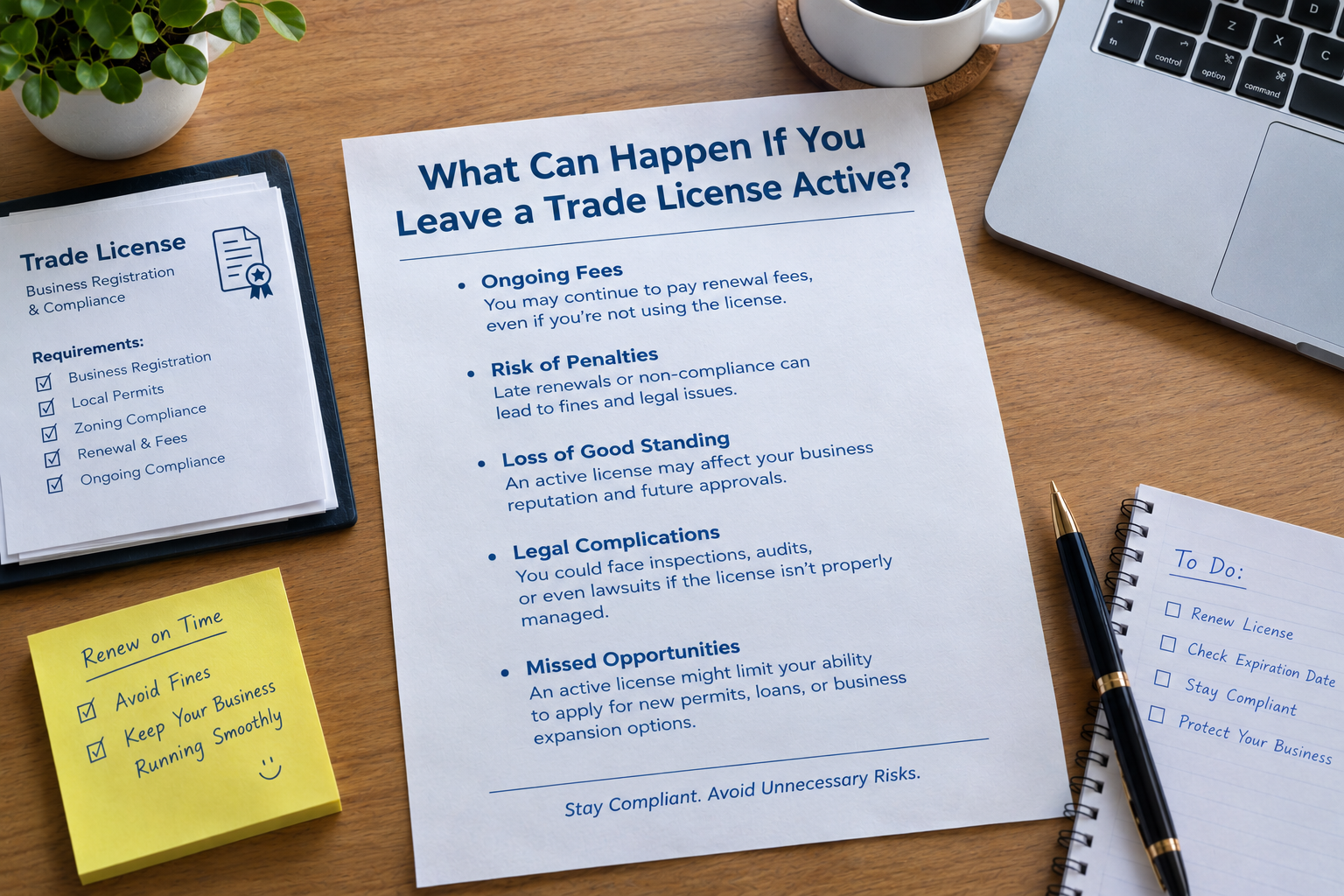
Use these checks to see whether the company’s formal closure is complete:
- Confirm the license is formally closed.
- Check for outstanding fines with the relevant authority.
- Verify employee, visa, and tax records are resolved.
- Retain the final cancellation certificate and clearance evidence.
DED and free zone authorities administer license records. Unpaid tax obligations involve the relevant tax authority. A company can stop trading but still have active registrations or unpaid amounts that need attention.
Possible problems include fines or penalties that continue to build, as well as blacklisting. An unresolved company record may also make future visa applications or business registration difficult. Legal action may follow unpaid dues or taxes.
The exact result depends on the company’s status and what remains unpaid or unclosed. Do not assume that a business is clear simply because it has no customers, staff, or recent transactions.
Keep the final certificate with proof that relevant clearances were completed. Keep the final certificate and clearance records together so you can show that closure was completed.
Do Requirements Change by Business Type?
An LLC, sole establishment, civil company, and freelancer license do not necessarily follow identical closure steps. Entity type affects whether liquidation, an auditor’s report, or professional clearances may be needed.
An LLC closure can involve liquidation and an auditor’s report, while a sole-establishment cancellation is described as simpler. The company’s legal form and licensing authority together determine which requirements apply.
An LLC may need the formal liquidation steps required for its case. That can include shareholder approval, a liquidator, and an auditor’s report when the authority or company’s circumstances require one. Do not assume that an LLC can use the same cancellation route as an individual establishment.
A sole establishment is described as having a simpler cancellation route. Simpler does not mean that every record closes automatically; the business still needs to follow its authority’s requirements and resolve applicable obligations.
A civil company may need additional professional clearances. The nature of its professional activity can affect which approvals or records must be addressed, so its owners should identify those requirements before applying.
Branches and freelancer licenses have their own entity and license details to consider. For covered Dubai Development Authority entities, including FZ-LLCs, branches, and freelancer licenses, deregistration follows the Private Company Regulations.
Partnerships are another business form that may have requirements tied to the company’s governing records. A generic checklist cannot safely replace the authority’s instructions for that form.
Before preparing a standard application, match the company’s legal name and entity type to its current license. Check both the entity type and the authority that issued its license before using a standard checklist.
How Can You Prepare to Start the Cancellation?
A short fact-finding pass can prevent you from starting with the wrong authority or an incomplete application. Start with the records that show who issued the license and what company obligations remain active.
A service provider can help coordinate paperwork and submissions, but only the competent authority can approve the closure. A focused preparation list can help you request useful guidance and avoid paying for work that does not fit your case.
Before requesting help or filing, work through these four checks:
- Confirm the license issuer and entity type.
- Collect the latest license and ownership details.
- Identify active employees, sponsored visas, premises, and tax registrations.
- Ask the relevant authority or service provider for a case-specific document list and written fee estimate.
Mainland routes may involve DED or ADDED, while free zone companies work with the relevant free zone authority. Abu Dhabi applications may go through TAMM or ADDED. The issuing authority determines which route is relevant to your license.
Different organizations hold different records. MOHRE handles labor matters, GDRFA handles sponsored residence visas, and FTA handles tax records. Listing the company’s active records helps you identify which organizations may need to be contacted.
When asking a provider for help, describe the company’s activity and current status rather than asking only for a general cancellation price. Request the specific document list and a written estimate for your case.
Coordination support can help organize submissions, but it cannot replace authority approval or settle an obligation on its own. Share the license type, issuing authority, and active company records when requesting a tailored assessment.
Get Help With Your UAE License Cancellation
If you want help coordinating the closure, start by asking what the service will handle and what remains your responsibility. Clear scope helps you understand whether support covers preparation, submissions, or follow-up.
A provider can help organize and track the work, but the competent licensing authority makes the final decision and issues the certificate. Support may include confirming the route, reviewing documents, and preparing resolutions and applications.
A service provider can coordinate the closure, but only the competent authority can approve it and issue the final certificate.

Ask how the provider will confirm the correct authority and entity route. Good preparation starts with matching the company’s current license to the proposed application path, not just sending a general form.
Document review can help spot missing signatures, ownership details, or outdated records before filing. A provider may also prepare a shareholder resolution and application, then coordinate submissions with DED or the relevant free zone authority.
Some cases need coordination with MOHRE, GDRFA, or FTA. Ask whether the service includes contacting those organizations, tracking their requirements, or only advising you about the steps. The scope should name the tasks it covers.
Before appointing a provider, request a written scope, a list of fees, and a clear explanation of what is included. Ask which actions you must complete yourself, such as providing signatures, settling accounts, or attending an appointment.
Processing depends on the company’s requirements and authority decisions. No service provider can promise a penalty-free, guaranteed, or fixed-time result when approvals and outstanding obligations remain involved.
Keep copies of the application, payment records, authority responses, and final certificate in one company file. Request a case review using your license copy and company details, then confirm the scope and quote before authorizing work.
Conclusion
A smooth company closure starts with the right authority route and a clear view of the records still open. Your entity type and license issuer shape the application, while employee, visa, tax, and other records may require separate closure.
The practical first step is to gather your current license and shareholder or owner details. Use those records to request an assessment tailored to your company, rather than relying on another business’s checklist or timeline.
Prepare your license copy and ask for a written outline of the required steps and costs.
FAQ
Can I complete a UAE company license cancellation while I am outside the country?
Yes, a representative may be able to handle some steps if you provide a valid power of attorney. The licensing authority or free zone may set its own rules about the document’s wording, notarization, or attestation. Confirm those requirements before your representative submits an application. You may still need to provide original records or complete actions that the authority does not accept through a representative.
Can I apply for cancellation if the company has unpaid fines?
Yes, you may be able to submit an application, but outstanding fines or liabilities may need to be cleared before final approval. The authority can review the company’s account and identify amounts that remain due. An application does not itself remove a fine or settle an unpaid obligation. Ask for a current account status and keep proof of payments made during the closure process.
Does the cancellation certificate automatically close the company bank account?
No, the trade license cancellation certificate does not automatically close a company bank account. Contact the bank separately and ask what it needs to close or change the account. The bank may request proof that the company has completed closure, along with its own forms and authorizations. Check for pending transactions, linked services, or remaining balances before treating the account as closed.
Does a company trade license cancellation automatically cancel employee visas?
No, employee visas and labor records require their own applicable cancellation steps. The responsible process depends on whether the records sit with MOHRE, GDRFA, or a free zone authority. Identify each employee’s work permit and sponsored residence visa, then obtain confirmation from the relevant organization. A closed trade license alone does not prove that an individual’s employment or residence record is closed.
Does a VAT-registered company need to deregister with the FTA during closure?
VAT-registered businesses may need to apply for VAT deregistration through FTA e-Services, settle tax liabilities, and submit final returns. The company should review its registration and filing position as part of closure. VAT deregistration is separate from trade license cancellation, so do not assume one application closes both records. Keep the FTA confirmation with the company’s final closure documents.
Do all UAE company types need a liquidator to cancel a trade license?
No, a liquidator is not required for every company type or cancellation route. An LLC may require liquidation steps and a liquidator, while a sole establishment or another entity may follow a different authority process. The exact requirement depends on the legal form, license issuer, and company status. Confirm those details before appointing a liquidator or relying on a standard closure checklist.
