
A remote employee weighing a move to the UAE can use the country’s virtual work program to live there while continuing an overseas job. A digital nomad visa is a residence authorization that lets someone live in a country temporarily while working remotely for an employer or clients based elsewhere. For expats and remote professionals, relocation can bring a new home without requiring a change to an existing overseas work arrangement.
The UAE Virtual Working Programme gives you a way to assess whether that move fits your work and personal plans. You can use this guide to understand eligibility, costs, documents, and timing before you commit to travel or housing. The details also help you spot where an emirate’s application process may affect your preparations.

Key Takeaways
- The program is intended for work tied to employers, clients, or businesses outside the UAE.
- Applicants need to meet the overseas-income threshold and show evidence that fits their work type.
- Prepare identity, work, income, and insurance records before submitting an application.
- Government fees are only part of the first-year budget.
- Dubai and Abu Dhabi have distinct application routes, so use the instructions for your emirate.
- Treat the listed requirements as a starting point, then confirm the application details with the authority handling your emirate.
What Is the UAE Remote Work Visa?
The UAE’s virtual work residence permit gives eligible remote workers a temporary residence route without changing their overseas work arrangement. A digital nomad visa is a residence authorization that lets you live temporarily in a country while working remotely for an employer or clients based elsewhere.
The UAE Virtual Working Programme, also called the Virtual Work Residence Permit, lets remote employees, freelancers, and business owners live in the UAE for one year while working for employers or clients outside the country. The terms digital nomad visa and remote work visa are often used interchangeably, but each country sets its own conditions.
A virtual work residence permit is not permission to take a job with a UAE employer.
The key distinction is where the work relationship is based. This residence permit supports an overseas work arrangement, while a local work authorization covers employment with a UAE employer. A tourist stay is different again: it allows a visit, not employment permission or residence through the virtual work program.
| Permission type | Work arrangement | What it allows |
| UAE virtual work residence permit | Employer, business, or clients outside the UAE | Temporary UAE residence while continuing overseas work |
| UAE local work authorization | Employment with a UAE employer | Work under the relevant local authorization |
| Tourist stay | Visit to the UAE | Tourism or a visit, not local work authorization |
These categories matter if you plan to keep working after arrival. A residence permit and permission to work are related, but they are not interchangeable. Check that the authorization matches where your employer, business, and clients are based before making plans around it.
Who Is Eligible for the UAE’s Virtual Work Permit?
You can qualify only if your work is based outside the UAE and your monthly overseas income reaches at least $3,500. The overseas-work condition matters as much as the income figure, so a high salary alone does not establish eligibility.
Applicants must earn at least $3,500 per month from sources outside the UAE. Your work arrangement must also fit the program’s purpose: you continue working remotely for a non-UAE employer, clients outside the country, or a business based abroad.
Use this short checklist to see whether your situation appears to fit:
- Your job, client base, or business is based outside the UAE.
- Your overseas income reaches at least $3,500 each month.
- Your work arrangement can be shown with evidence suited to your employment type.
- Your personal income records support the amount used in your application.
Eligibility is not based on income alone. For example, a person earning well above the monthly threshold through a UAE-based job does not meet the overseas-work condition simply because the salary is high. The permit is designed for digital nomads and other remote professionals who continue an overseas work arrangement.
Freelancers should think about whether their professional activity, clients, and earnings can be tied to work outside the UAE. Employees should be able to show a continuing relationship with an overseas employer. Business owners need to connect their role and personal income to a company outside the country.
Income documents should support the same work arrangement described in the application. If your job, clients, or business structure recently changed, make sure the records you submit reflect that change clearly. Compare your actual work arrangement with the program’s overseas-income rule before collecting paperwork.
How Do Employees, Freelancers, and Owners Prove Their Work Status?
The right evidence depends on whether your income comes from an employer, freelance clients, or a company you own. Your proof of employment or business activity should show a real overseas work arrangement and fit your application category.
Choose records that tell a consistent story about your role and income. Dubai employment applicants may need a contract covering at least one year. Keep that term in mind when checking whether an existing agreement supports your planned stay.
Evidence for Remote Employees
Remote employees can use an employment contract, an employer letter, a salary certificate, or equivalent payroll documentation. These records should identify the employer and make the applicant’s overseas role clear. A practical file might pair an employer letter confirming remote work with recent payroll records that show continuing salary payments.
If your contract is brief or does not describe remote work, a separate employer letter can help explain the arrangement. Check that the name and role in that letter match your contract and salary documents. An employee should not rely on a job title alone to establish where the employer is based.
Evidence for Freelancers
Freelancers need records showing professional activity registered abroad, clients located outside the UAE, and qualifying monthly income. Foreign client agreements can show where the work comes from, while overseas business registration documents support the location of the professional activity.
For example, a freelancer could pair registration records from their home country with signed agreements for overseas clients. Invoices and payment records can connect those agreements to actual income. Client paperwork should make the working relationship understandable, rather than presenting a folder of unrelated transactions.
Evidence for Business Owners
Business-owner applicants need to document a company incorporated outside the UAE, proof of ownership or operation, and personal income from non-UAE sources. Company records establish the business connection; personal financial records show the owner’s own income.
A company registration certificate combined with ownership records and personal payment records may explain how the business supports the applicant. Company revenue and personal income are not automatically the same thing, so describe the connection through clear records. Keep the business or client records consistent with the personal income you use to qualify.
Which Documents Should You Prepare?
Start by checking the passport’s remaining validity, since it must cover at least six months from the application date. A complete file also needs a recent color passport-style photo with a white background and records that support your work category.
A Dubai application does not require proof of address, so you do not need to wait for a UAE lease before applying. Organize the documents below into clear groups, with readable copies and matching names wherever possible.
- Passport and photo: Include a passport valid for at least six months from the application date and a recent color passport-style photo with a white background.
- Employment or business evidence: Add an employment contract, employer letter, overseas business registration, or other records suited to your work arrangement.
- Income evidence: Include a salary certificate, payslips, and bank statements that help show monthly income from outside the UAE.
- Bank statements: Some application checklists request six months of statements, so prepare that period if your checklist calls for it.
- Supporting client records: Freelancers can add client agreements, invoices, or other documentation that supports their overseas professional activity.
Keep the file focused on records that establish identity, work, and income. A salary certificate can state current monthly gross salary for an employee, while payslips show payments across a period. Freelancers and owners may need several connected records to explain both the work and the source of personal income.
Some applicants assemble documents before choosing an address, but that is not a prerequisite for a Dubai application. Store digital copies with clear file names so you can find a particular contract or statement during submission. If a record is not in English, confirm the relevant emirate’s instructions for supporting documents.
Review the application file for small mismatches before sending it. Different spellings, changed job titles, or inconsistent payment details can make a clear work arrangement harder to assess. Make sure the names and income details match across your employer letter, payslips, and bank records.
What Health Insurance Must You Carry?
A policy must cover the UAE and be valid for residency purposes, not merely provide emergency cover during a short visit. Residency-ready coverage is the relevant standard for this application, rather than a policy that works only in your home country.
Valid health insurance covering the UAE is required for the virtual work residence permit. Check the policy wording and eligibility terms, not just the summary of medical benefits or a card showing that you have insurance.
Coverage That Works for UAE Residency
A home-country health plan may not cover care in the UAE. Travel insurance may cover emergencies during a trip but still fail to meet residency needs. Look for clear confirmation that the policy includes UAE coverage and can be used for a UAE residence application.
Read the policy documents for limits on where you can receive treatment and when coverage applies. A general statement that a plan offers international benefits may not explain whether the UAE is included. If the wording is unclear, ask the insurer to confirm the specific residency-related coverage in writing.
Match the Policy to Your Stay
The permit is expected to cover a one-year residence period, so choose insurance that suits that planned stay. A policy ending well before the expected residence period can leave a gap in your coverage dates.
Check the start and end dates, the UAE coverage wording, and any residency eligibility terms together. That small review is more useful than relying on a policy’s broad medical benefits alone. Check the policy’s validity dates against the full residence period before submitting it.
How Much Does the UAE Permit Cost?
Budget for both government fees and the wider costs of completing a first-year move. The full budget is larger than the fee charged for the permit, because insurance and other choices can add to the total.
Government fees are AED 2,500-3,000, while the estimated total first-year cost is $800-$3,000 or more. Those figures use different currencies and describe different parts of the budget.
| Cost item | Amount | What changes the amount |
| Government fees | AED 2,500-3,000 | Application and government charges |
| Estimated total first-year cost | $800-$3,000+ | Insurance, dependents, medical test speed, and agent use |
| Variable expenses | Depends on choices | Insurance plan, dependents, medical testing, or agent use |
The first-year estimate is not the government-fee figure converted into dollars. It covers a wider set of possible costs and can change with your personal choices. For example, adding dependents can raise expenses, and using an agent adds a service cost beyond the government charge.
Health insurance is another major part of the overall move budget, with the amount shaped by the policy you select. Medical testing speed and how you handle the application can also affect expenses. Keep a separate line in your budget for each item instead of treating one figure as the entire cost.
These estimates can help you decide whether to begin preparing an application, but your own totals depend on what you choose and need. Separate fixed government charges from costs that shift with insurance, family plans, or outside help. Build your own estimate around your insurance choice and whether you will include dependents or use an agent.
How Do You Submit an Application?
For the Dubai route, you can submit the application online through GDRFA rather than making an embassy appointment. The online route lets you complete the application and provide supporting records through the Dubai authority’s service.
Dubai applications are handled through the General Directorate of Residency and Foreigners Affairs (GDRFA). An embassy visit is generally not needed for this online process.
Use a simple sequence to keep the submission organized:
- Gather your supporting documents and check that names, dates, and income details agree.
- Open the GDRFA online service for the Dubai virtual work application.
- Complete the application fields and upload the supporting files in the requested format.
- Pay the fee displayed in the service and submit the application.
- Follow the status updates and any instructions issued for your application.
Save a copy of the submitted application and payment confirmation. Those records can help you track the case and respond if the application requires follow-up. Use the current service instructions for the documents and fields, since the online process can ask for details specific to your case.
Applicants already in the UAE may need to provide a copy of their current visit visa or residence visa, along with their Emirates ID. After entry permit approval, they should complete a status change immediately. This step applies to applicants inside the country and is separate from submitting the online application.
Before you submit, make sure the files are legible and attached to the correct application fields. Keep the status-change step in view if you are applying from inside the UAE, because entry permit approval does not complete it for you. If you are already in the UAE, check the status-change instructions as soon as your entry permit is approved.
How Long Does Approval Take?
GDRFA lists 48 hours as the expected completion time when the application file is complete. That estimate applies to the application processing stage, not every step needed before you can settle in.
A complete-file application has an expected processing time of 48 hours. Medical fitness testing and Emirates ID procedures still take time after approval, so allow for those steps when planning a move.
| Stage | Timing | What happens |
| Complete-file processing | Expected completion in 48 hours | Application review and decision |
| Medical fitness testing | After approval | Applicant completes the medical fitness step |
| Emirates ID procedures | After approval | Applicant completes the identity-card procedures |
The 48-hour estimate is tied to a complete application file. Missing details or documents can affect how smoothly the case moves through the process. Treat the figure as an expected completion time, not as a promise that every part of your residence setup will be finished within two days.
Once the application is approved, arrange time for the required medical fitness and Emirates ID procedures. These steps come after the decision and matter to your practical move schedule. Avoid booking a move-in date that assumes approval alone completes the residence process.
Allow for the approval stage and the tasks that follow it when coordinating travel, housing, and work plans. A small buffer is useful if your arrival depends on completing post-approval procedures. Leave a buffer after approval for the medical fitness and Emirates ID steps before fixing a move-in date.
Can You Bring Family Members?
Dubai virtual work visa holders can sponsor family members, so a solo application is not the only option. A family move requires relationship documents and separate planning for each dependent’s application needs.
Dependent sponsorship can add paperwork and fees, so account for each family member before finalizing your plans. Marriage or birth certificates may be needed to prove the relationship.
Use these checks to organize a family application:
- Identify every family member you intend to include as a dependent.
- Prepare a marriage certificate for a spouse or birth certificates for children, as relevant.
- Ask how additional application fees apply to each dependent.
- Confirm each family member’s separate health insurance needs.
Relationship records should match the people named in the dependent applications. If a certificate is unavailable or has details that differ from passports, resolve those questions early rather than leaving them until submission. Each dependent’s paperwork is an added part of the move, not a detail handled automatically by the main application.
Family planning can also affect your move date. A missing certificate or incomplete insurance plan for one person may slow the household’s arrangements even when the primary applicant is ready. Gather relationship certificates early so dependent paperwork does not become the last-minute part of the move.
What Work Is Allowed Under This Permit?
This permit is for work tied to an employer, business, or client base outside the UAE. The location of the work relationship determines whether the virtual work residence permit fits your arrangement.
A UAE-registered employer or UAE local clients require a different work authorization. The virtual work permit does not provide open access to the UAE job market.
| Work scenario | Allowed under the virtual work permit | What to do |
| Non-UAE employer | Yes, for remote work | Continue the overseas work arrangement |
| Clients outside the UAE | Yes, for remote client work | Keep the work tied to overseas clients |
| UAE-registered employer or UAE local clients | No | Obtain a different work authorization |
An overseas employer may let you perform your job from the UAE, but the employer remains based outside the country. Freelancers can serve clients abroad under the same basic distinction. The permit is not a general work visa for taking any job available locally.
If a client relationship moves into the UAE, or an overseas employer hires you through a UAE-registered entity, the arrangement may no longer fit this permit. The place where you sit while working does not change the location of the employer or client relationship. Check the authorization that applies to the actual arrangement before changing how you work.
Remote work can cross borders easily, but immigration permission still depends on the work arrangement. Do not assume that a short local project falls under an overseas-work permit simply because your main job remains abroad. If a role or client relationship shifts into the UAE, check the required authorization before accepting the work.
What Tax Questions Should You Check Before Moving?
Dubai does not levy personal income tax on individuals, but that fact alone does not settle your tax position everywhere. Your wider tax picture can depend on where you remain tax resident and how your work or business is organized.
Dubai’s individual personal income tax position does not automatically make every income or activity tax-free. Residence in the UAE and tax treatment in another country are separate questions.
Your Dubai Tax Position
Consider your personal circumstances rather than treating a UAE residence permit as a complete tax answer. An individual’s tax position may involve more than the country where they currently live. Your income type and the rules that apply to your activities can matter.
Business tax obligations are separate from an individual’s residence status. If you own a company, moving yourself does not by itself explain how the company should meet its obligations. Keep personal tax questions distinct from business compliance questions when planning the move.
Your Home-Country and Business Obligations
Your home country may continue to apply tax rules based on your circumstances. Tax treaties, tax residence, and company obligations also need individual assessment. A move does not automatically end every connection to a former country of residence.
Keep records of where you live and work, and seek qualified advice for a specific situation. A tax adviser can assess both your personal residence position and any business obligations in light of your facts. Before relocating, ask a qualified tax adviser to assess both your personal residence position and any business obligations.
Where Can You Apply in Dubai or Abu Dhabi?
Dubai and Abu Dhabi both offer a route for remote workers, but the application details are emirate-specific. Choose the right route based on where you intend to establish residence, rather than assuming one application service covers every emirate.
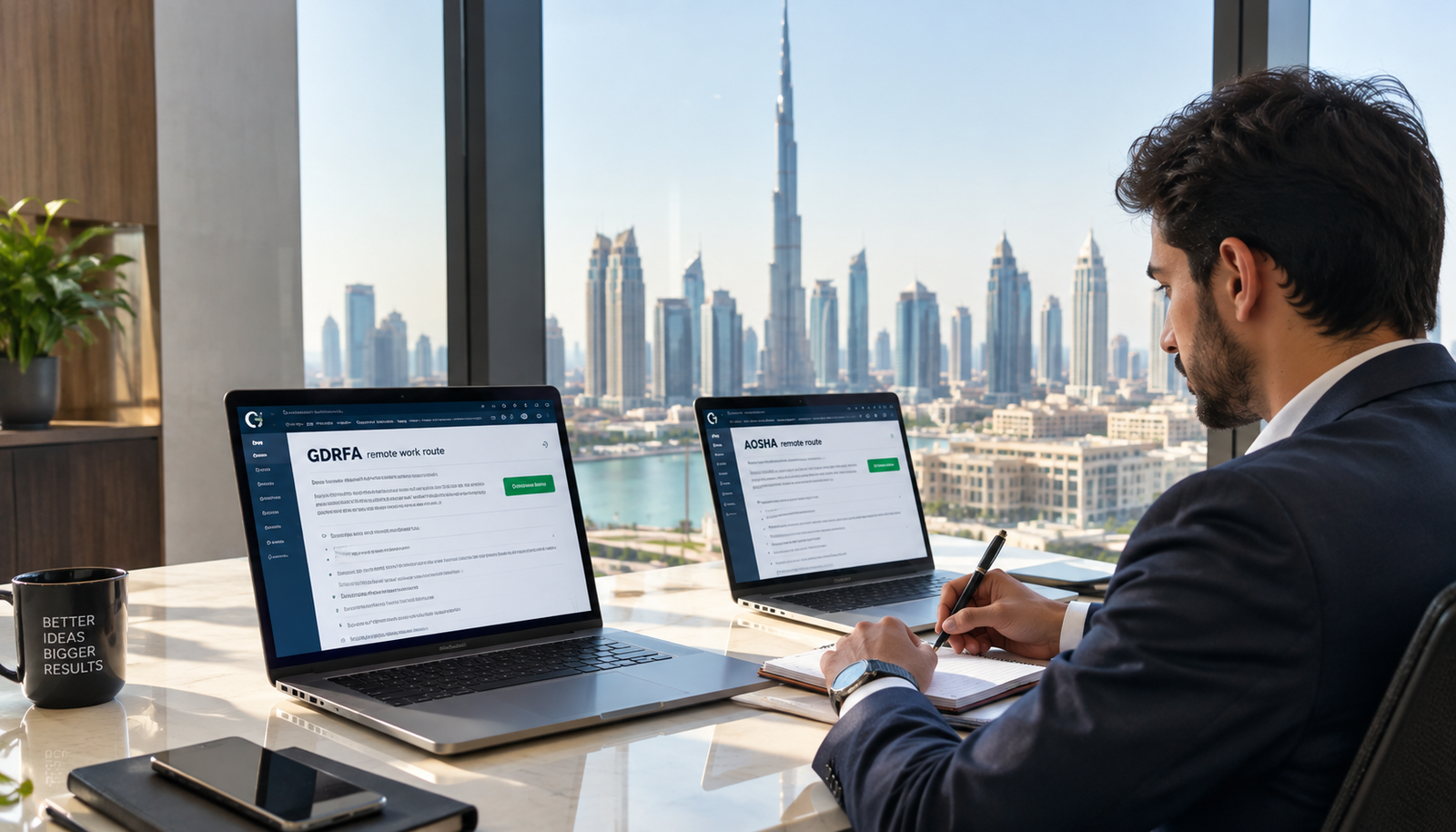
Dubai’s online virtual work application is handled through GDRFA. Abu Dhabi has a separate Remote Work Visa with its own stated conditions and application instructions.
Dubai’s Online Application Route
For Dubai, the General Directorate of Residency and Foreigners Affairs (GDRFA) handles the online application route. Use the Dubai authority’s service and follow its instructions for the virtual work residence permit. The relevant route is tied to Dubai, so do not assume a different emirate uses the same process.
Keep the emirate in mind when preparing your application and choosing where to establish residence. Application details can differ, even when both routes serve remote workers. A familiar portal is not necessarily the correct one for every location.
Abu Dhabi’s Remote Work Visa
Abu Dhabi offers a Remote Work Visa that lasts one year and is renewable. It does not require a national sponsor. Those features distinguish the Abu Dhabi route, but they do not make its application process identical to Dubai’s.
Read the instructions for the emirate where you plan to live, including the authority’s current application requirements. Using the wrong route can create avoidable delays or leave you with the wrong application guidance. Confirm the correct authority for the emirate where you intend to establish residence before submitting an application.
Does This Permit Lead to Permanent Residency?
No, a Dubai virtual work visa does not itself grant permanent residency or citizenship. It is a temporary residence route for remote work, not a promise of permanent settlement.
The UAE Golden Visa is a separate route to explore, but having a virtual work permit does not establish that you qualify for it. Treat long-term residence and citizenship as separate questions from this permit.
Before choosing a route, consider these three decision checks:
- Decide whether your goal is temporary residence or long-term settlement.
- Assess whether the UAE Golden Visa may be relevant to your circumstances.
- Seek professional advice before relying on a different immigration route.
The virtual work route can support a period of living in the UAE while you continue overseas work. It should not be treated as a step that automatically turns into a permanent status. A Golden Visa is a distinct option, and you need to assess its requirements separately.
Think about the length and purpose of your move before building a long-term plan around a temporary authorization. An immigration professional can help you assess another route against your circumstances, without assuming eligibility. If long-term settlement is your goal, assess a separate UAE residence route before making the move.
How Do You Renew the Permit?
The UAE virtual work residence permit is renewable annually. Renewal is not automatic, so keep your work and income records current and follow the authority’s instructions for your case.
Plan for a fresh compliance check each year, rather than assuming the existing permit will simply extend. Your overseas work arrangement and qualifying income should still be supported by up-to-date evidence.
Annual renewability does not guarantee an extension; you still need to meet the current requirements.
Check Your Continuing Eligibility
Keep records showing that your work remains tied to an employer, client base, or business outside the UAE. Update income documents as your pay, client work, or business activity changes. The records should reflect your current situation, not only the circumstances of your first application.
If your work arrangement changes during the year, review whether it still fits the permit’s purpose. A shift to a local employer or local clients can affect which authorization applies. Keep documents that connect your work and income together as your circumstances develop.
Follow the Current Renewal Instructions
Check the current renewal instructions from the authority handling your case. Allow time to gather updated records and complete any steps the authority requires. A renewal process may ask you to provide current evidence rather than rely on the file from your initial application.
Mark the permit’s expiry date on your calendar and begin checking the process well ahead of it. That gives you time to collect changed employment, business, or income records. Set a reminder well before the current permit expires to confirm the renewal process with the relevant authority.
Conclusion
The UAE route may suit you if your work and income remain tied to employers, clients, or a business outside the country. For expats, the central decision is whether the virtual work residence permit matches the way you actually earn and work.
A complete, consistent application file makes planning more straightforward. Compare your work arrangement with the eligibility conditions, then check the current instructions for the emirate where you intend to live.
Start by checking your overseas work evidence and the $3,500 monthly income requirement against your own situation.
FAQ
Can I apply for the UAE virtual work permit while I am already in the country?
Yes, you can apply while inside the UAE, though you may need to provide your current visit visa or residence visa and Emirates ID. After entry permit approval, complete the required status change immediately. Check the instructions that apply to your application so you know which current UAE documents to include and where to complete the status change.
Is the $3,500 income threshold based on gross salary?
Employees can use a salary certificate showing current monthly gross salary as evidence, alongside records such as payslips. Freelancers and business owners need to show qualifying personal income from outside the UAE, not simply business revenue or a high total on a company account. Make sure the income documents support the work arrangement described in the application.
Can my spouse work after I sponsor them as a dependent?
No, dependent sponsorship by itself does not authorize your spouse to take a job in the UAE. If your spouse plans to work for a UAE employer or serve local clients, they should check the separate work authorization required for that arrangement before accepting the work. Residence as your dependent and permission to work are different permissions.
Does the virtual work permit settle my tax obligations in my home country?
No, the UAE virtual work permit does not settle your home-country tax obligations. Your home country’s rules and any relevant tax treaty can still affect your individual position, including how tax residence is assessed. Business obligations may also need separate review. Ask a qualified tax adviser to assess your personal and business circumstances before relocating.
Do I need a UAE address before applying in Dubai?
No, a Dubai application does not require proof of address. You do not have to secure a UAE lease before submitting the application, so housing does not need to be the first step in your preparations. Check the current application instructions for other required records, and plan accommodation separately around your expected move.
Can I renew the permit automatically?
No, renewal is not automatic. The permit is renewable annually, but you should confirm the current renewal steps and continuing eligibility with the authority handling your case. Keep your overseas work and income evidence current, then allow time to gather any updated records the renewal process requires before the existing permit expires.
