
A valid UAE residence visa can let you sponsor eligible relatives, provided you meet the income and other requirements. A Dependent Visa can help you bring loved ones to live with you, but the rules depend on your emirate and your relationship to each family member. An entry permit is temporary immigration approval that allows a dependent to enter the UAE or change status before the residence visa is issued.
This guide explains how UAE residents can check eligibility, prepare paperwork, budget for costs, and understand the application process. Requirements may differ between emirates and between spouses, children, parents, and other relatives. Knowing which rules apply before you apply can save your family time and avoid preventable delays.

Key Takeaways
- A valid UAE residence visa is the starting point for sponsorship.
- Salary, housing, and relationship requirements depend on the case.
- Prepare valid identity papers and proof of family relationship.
- Adult dependents need medical fitness clearance and health coverage.
- Dubai applications go through GDRFA Dubai; other emirates use ICP.
Check the rules for the emirate where you live before preparing an application.
Who qualifies for a UAE Dependent Visa?
A resident employee, investor, or partner can sponsor eligible relatives if their UAE residence visa is valid. Your own status must remain active throughout the sponsorship process, and the relationship must fit the applicable family rules.
A sponsor must hold a valid UAE residence visa and meet the conditions that apply to the sponsor’s emirate and family member. Male and female expatriate residents may both sponsor family when they meet those conditions.
Male and female expatriate residents can sponsor eligible family members when they meet the applicable conditions.
Eligible sponsor types include employees, investors, and partners. A sponsor’s visa category does not remove the need to meet the rules for the dependent’s relationship and application.
Application channels differ by emirate. Dubai residents use GDRFA Dubai, while ICP provides federal immigration services for other emirates. Follow the channel that handles applications where you live.
Check the sponsor’s residence record and visa expiry date before beginning an application. A residence visa that is expired or cancelled cannot support a new family application.
Start by checking that the sponsor’s own residence status is active.
What salary and accommodation must a sponsor show?
A sponsor meets the standard income threshold by earning AED 4,000 monthly, or AED 3,000 monthly with company accommodation. These are two routes to meet minimum salary requirements for family sponsorship.
The minimum salary is AED 4,000 per month, or AED 3,000 per month plus company accommodation. The lower salary route depends on accommodation supplied by the employer, not simply on having a home in Dubai.
Dubai’s application checklist accepts a salary certificate or bank statement as income proof. Either document should clearly show the sponsor’s income for the authority reviewing the application.
For housing proof in Dubai, an Ejari-registered tenancy contract is a practical document to prepare. It proves a home address, while company accommodation supports the specific lower-salary route.
These documents serve different purposes. A salary certificate or bank statement shows income; a tenancy contract shows housing. One does not replace the other.
Rules and accepted evidence may vary by emirate or application channel, so use the requirements that apply to your case. Keep income and accommodation records current when you submit.
Match each document to the requirement it proves, since salary evidence does not replace accommodation evidence.
Which family members can be sponsored, and what age rules apply?
Spouses and eligible children are the central family categories, while parent sponsorship can involve extra conditions. The relationship matters because each family member must meet the rules for that category.
Sons may be sponsored up to age 25, and daughters must be unmarried under the family-visa rules listed in October 2026. A spouse may qualify with proof of marriage.
Spouses and children
A spouse application needs an attested marriage certificate to establish the relationship. Children’s eligibility depends on their age and, for daughters, marital status under the stated family-visa rules.
A UAE-born newborn has a separate deadline: the family must apply for the baby’s residence visa within 120 days of birth. This deadline concerns the residence application, not the newborn’s insurance enrollment.
| Family member | Relationship evidence | Key eligibility condition |
| Spouse | Marriage certificate | Certificate must be attested |
| Children | Birth certificate | Sons up to age 25; daughters unmarried |
| Parents | Proof of parent-child relationship | Additional conditions can apply |
Parents and other family situations
Parents may qualify, but their cases can involve conditions beyond standard spouse or child sponsorship. Do not assume that a parent application follows the same eligibility test as a child’s.
Other family situations, such as stepchild sponsorship, may need extra evidence or consent documents. The immigration authority assesses the specific relationship and supporting papers for that case.
For a newborn born in the UAE, submit the residence-visa application within 120 days of birth.
What documents should families prepare?
Prepare the sponsor’s identity documents and each applicant’s passport and photograph before submitting the application. Clear, current records make it easier for the authority to confirm each person’s identity and relationship.
Each applicant’s passport must have at least six months of validity remaining. The sponsor also needs a valid UAE residence visa and Emirates ID for the standard family application.
- The sponsor’s valid UAE residence visa.
- The sponsor’s Emirates ID.
- Each applicant’s passport, valid for at least six months.
- A recent passport-size photograph for each applicant.
- An attested marriage or birth certificate, as applicable.
The relationship certificate depends on the family member applying. A spouse uses a marriage certificate; a child uses a birth certificate to show the parent-child relationship.
Make sure names and personal details are consistent across the passport and relationship certificate. Differences in spelling or other identity details can prompt questions during document review.
Prepare a separate set of identity papers for each dependent rather than treating one relative’s documents as proof for the whole family. Each applicant needs an individual passport and photograph.
Check that every passport has at least 6 months of validity remaining.
How must foreign marriage and birth certificates be attested?
A certificate issued abroad needs a chain of attestations before it can support a UAE family application. Each authority in the chain confirms the document for use by the next authority.
Foreign marriage and birth certificates must be attested in sequence by authorities in the issuing country and the UAE. The exact steps are:
- The issuing country’s notary and foreign ministry.
- The UAE Embassy in the issuing country.
- The UAE Ministry of Foreign Affairs in the UAE.
Complete the issuing-country steps first, then arrange embassy attestation there. The final attestation takes place through the UAE Ministry of Foreign Affairs after the certificate reaches the UAE.
A legal Arabic translation may also be required for the document being submitted. Translation needs can depend on the authority and the certificate’s language, so include the translation in the file when required.
Use a translation that matches the certificate presented for attestation. A translation for the wrong document version can create a mismatch during review.
Keep the original certificate and its completed attestations together when submitting the family application. This helps the immigration authority match the proof of relationship with the applicant’s file.
Arrange the translation in the form accepted by the relevant immigration authority.
What medical tests and health insurance do dependents need?
Every applicant aged 18 or older needs medical fitness clearance, while children under 18 skip the medical steps. Age determines whether the medical test applies to a dependent.
Valid health insurance is required for expatriate residence issuance and renewal. Immigration authorities will not issue or renew a residence permit without valid coverage.
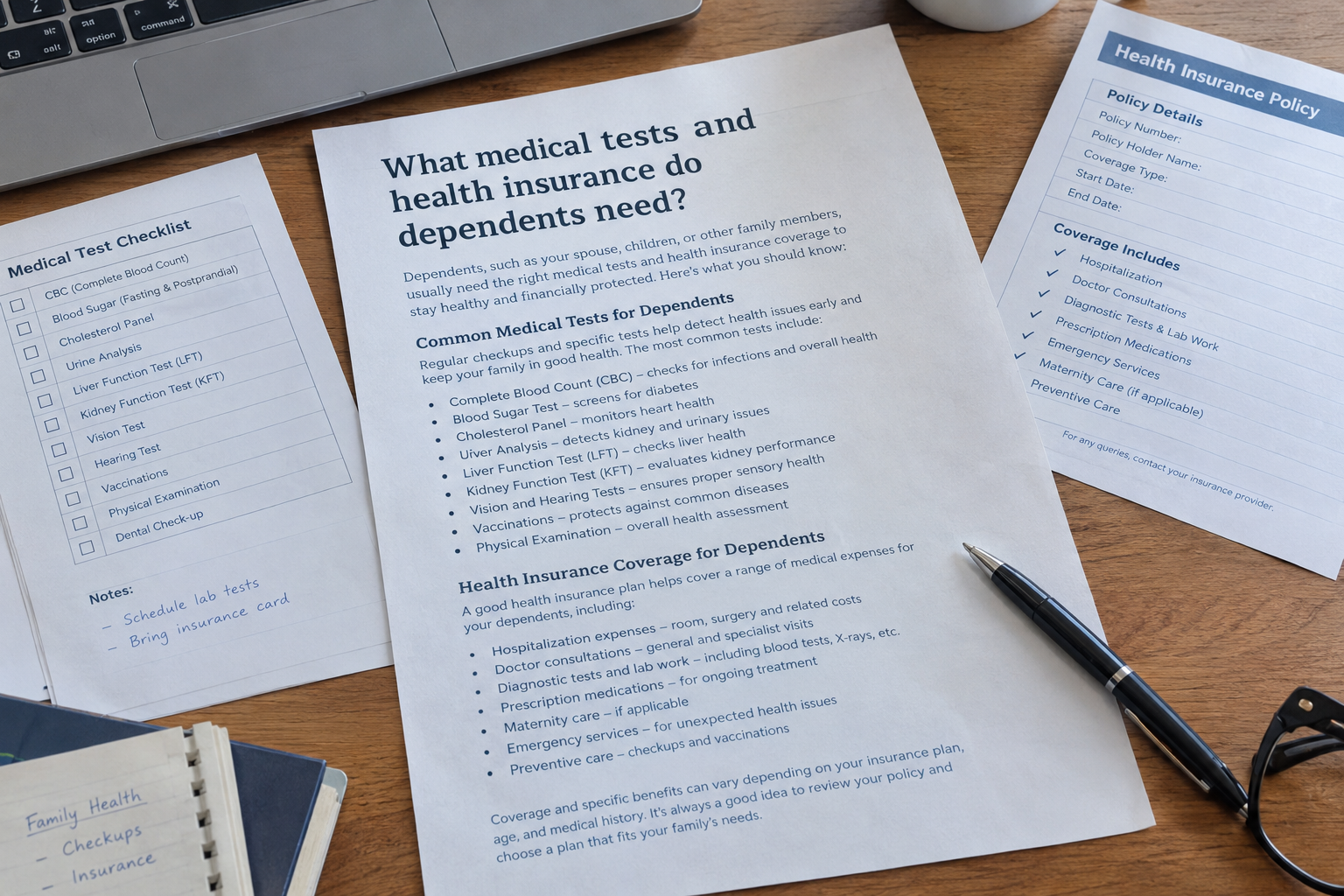
Medical fitness testing applies to adults aged 18 and older. Children under 18 do not complete the medical steps for residence applications.
- Applicants aged 18 or older complete medical fitness screening.
- Children under 18 skip the medical steps.
- Dependents need valid health coverage for residence issuance and renewal.
- Newborns must be added to their health policy within 30 days of birth.
Health coverage for a dependent is distinct from an employer’s insurance arrangement for workers. From January 1, 2025, employers or sponsors must arrange health insurance for private-sector employees and domestic workers.
That arrangement rule does not replace the dependent’s own coverage requirement for residence. The family needs to ensure the dependent has valid insurance attached to their residency.
The newborn deadline is specific: under the DHA requirement, add a baby to the health policy within 30 days of birth. This insurance date is separate from the residence application deadline.
Add a newborn to the health policy within 30 days of birth.
How do you apply for a family residence visa?
The process begins with an entry permit application, not with the residence visa itself. The entry permit allows a dependent to enter the UAE or change status before the final residence approval.
A residence visa is issued after required medical testing and Emirates ID registration are complete. Dubai applications go through GDRFA, while applications in other emirates go through ICP.
Apply for entry and complete the in-country steps
Follow the application in order so the dependent completes each required step before residence issuance:
- Apply for the dependent’s entry permit.
- Enter the UAE using the permit or complete a change of status.
- Complete medical screening if the applicant is aged 18 or older.
- Apply for the dependent’s Emirates ID.
- Receive the residence visa after the required checks.
A dependent outside the UAE enters using the permit. A dependent already in the country completes the status-change process instead of leaving and re-entering.
Finish identity registration and residence issuance
Applicants aged 18 and older complete medical screening as part of the in-country process. Every dependent also applies for an Emirates ID, the identity document issued to UAE residents.
Once the medical test and Emirates ID registration are complete, the authority can issue the residence visa. Track the application through the correct immigration channel for the emirate.
Treat the entry permit and the residence visa as separate stages of the same application.
How much does a UAE dependent visa cost?
Budget AED 2,500-8,500 or more for a Dubai residence visa, before adding health insurance. The final total depends on the emirate, visa duration, and service channel.
Health insurance is a separate cost from the Dubai residence-visa estimate. Common charges include an entry permit, medical fitness test, and Emirates ID, though final fees can differ by route.
Main application and identity fees
Typical estimates put an entry permit at AED 500-1,200, medical fitness at AED 250-350, and Emirates ID at AED 250-400. These line items help families plan the main application and identity costs.
| Cost item | Typical amount | What it covers |
| Entry permit | AED 500-1,200 | Temporary entry or status-change approval |
| Medical fitness test | AED 250-350 | Medical screening for applicants aged 18 or older |
| Emirates ID | AED 250-400 | Resident identity registration |
Insurance and other cost factors
Basic annual health insurance is estimated at AED 600-800 or more, paid separately from the residence-visa cost. Coverage options and policy prices affect the amount a family pays.
Dubai’s total estimate can rise above AED 8,500, depending on the case. The emirate, residence-visa duration, and service channel each affect the final total.
Ask for an itemized payment amount before you submit, so you can distinguish immigration charges from insurance and other service costs.
Confirm the current itemized fees for the emirate and application route before paying.
How long does the visa last, and how long does processing take?
A standard family-sponsored dependent visa is generally valid for 2 years and can be renewed. That is the standard route; Golden Visa family permits match the primary visa’s duration.
A completed application usually takes 2-7 business days to process after required documents and medical tests are complete. Incomplete files or pending checks can affect timing.
Residence-visa validity
Validity depends on the sponsorship route. Standard family sponsorship usually gives a two-year residence period, while a Golden Visa dependent receives a permit for the same duration as the primary visa.
| Sponsorship route | Permit validity | Key condition |
| Standard family sponsorship | 2 years | Renewable family-sponsored permit |
| Golden Visa family sponsorship | 5 or 10 years | Matches the primary visa duration |
| Family sponsorship by a UAE citizen | 5 years | Separate UAE citizen route |
Application processing time
Processing usually takes 2-7 business days once the authority has the required documents and medical results. The estimate starts after those items are complete, not when a family first begins preparing.
Golden Visa dependents receive permits that match the primary visa, which may last 5 or 10 years. The permit duration therefore follows the sponsor’s Golden Visa period.
Check the status through the immigration channel handling the application if the expected processing window passes without an update. Keep the application reference available when you ask.
Treat processing estimates as working expectations, not a substitute for checking application status.
What happens when a sponsor’s visa expires or is cancelled?
A dependent’s status is tied to the sponsor’s residence visa, so a sponsor’s cancellation affects the whole family application. Act promptly when the sponsor’s status changes, because each dependent’s residence record needs attention.
Dependent visas must be cancelled when the sponsor’s visa is cancelled. Family-sponsored dependent visas can also be renewed when the sponsor’s status and the family’s requirements remain in order.
A Dubai residence-visa guide gives a 60-day grace period after visa expiry before fines begin. That period is specific to the Dubai guidance and should not be treated as a universal deadline for every emirate or case.
Check the status and required action for each dependent separately. A family should not assume that the sponsor’s own renewal automatically updates every dependent’s record.
- Check each dependent’s current status.
- Arrange renewal or cancellation as required.
- Confirm the applicable grace-period deadline with the relevant authority.
Keep copies of cancellation or renewal confirmations with the family’s records. This gives you a clear reference if an authority asks about a dependent’s status.
Confirm the deadline that applies to your case before relying on a grace period.
Can dependents work or study in the UAE?
A dependent may study in the UAE, but the residence visa alone does not authorize paid work. Permission to reside and permission to work are separate legal statuses.
A dependent who takes a job must obtain a separate work permit from the employer. The residence visa allows the family member to live in the UAE, not to begin employment automatically.
Dependents may enroll in schools or universities in the UAE. A family-sponsored residence status can support a student’s stay, while the school or university handles its own admission process.
For employment, the employer must arrange the required work permit before the dependent starts working. This requirement applies even when the dependent already has valid residence in the UAE.
A dependent visa does not function as a work permit, and a job offer does not change that automatically. The employer’s permit process provides the separate authorization needed for work UAE situations.
Before starting a job, make sure the employer has arranged the required work permit.
Conclusion
Bringing eligible relatives to live with you in the UAE starts with confirming that your own residence status and sponsorship conditions are in order. Valid relationship documents are another practical starting point, especially when certificates were issued abroad.
Rules and application channels differ by emirate, so use the route that handles your residence and family case. Check the current requirements with GDRFA Dubai or ICP for your emirate before you submit.
FAQ
Can I sponsor a stepchild for a UAE family visa?
Yes, you may be able to sponsor a stepchild, but the application can require extra evidence. Authorities may ask for a no-objection certificate from the biological parent and proof of custody. The documents depend on the family’s circumstances and the immigration channel handling the case, so prepare evidence that clearly explains the child’s relationship to you.
Does a mother need the father’s permission to sponsor a child?
A father’s no-objection certificate may be required for a mother sponsoring a child. In the RAKEZ process, an NOC from a father living abroad needs foreign-ministry attestation and an Arabic translation. The exact requirements can depend on the authority and case, so check the process that applies to your application before submitting the child’s papers.
Can I sponsor my parents on the same salary threshold as my spouse or children?
No, do not assume that the standard AED 4,000 salary route, or AED 3,000 with company accommodation, covers parent sponsorship. Parent applications can have additional conditions beyond the usual spouse or child route. Check the parent-specific requirements for your emirate and immigration channel before deciding whether your income and documents are sufficient.
Can a UAE citizen sponsor a foreign family member for a UAE residence visa?
Yes, a UAE citizen may sponsor a foreign-passport spouse, parent, or child for a 5-year residence visa. The dependent does not need to work in the UAE to hold that residence status. The application remains a family sponsorship case, so the relationship and identity documents must support the application.
Can a UAE citizen sponsor a foreign widow or divorced mother of a UAE national?
Yes, the oldest child can sponsor the mother for a UAE residence visa if she is a foreign widow or divorced mother of a UAE national. The case is different from an ordinary spouse application because the adult child acts as sponsor. The family should confirm the required relationship and status documents with the relevant immigration authority.
